
A Life of Reinvention
Vital Statistics
- Born: July 1844, Grainger County, Tennessee
- Died: 1913, Pike County, Kentucky
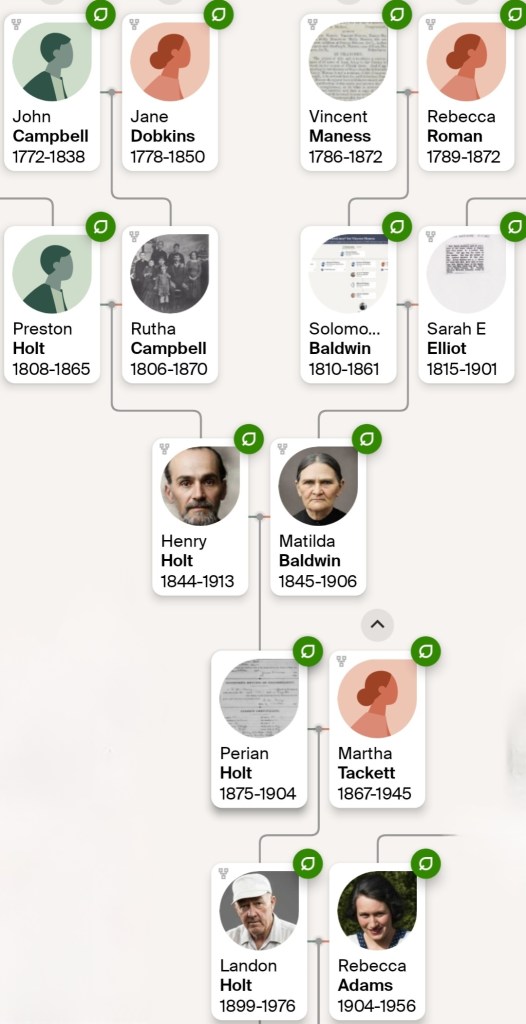
- Parents: Preston Holt and Rutha Campbell
- Spouses: Matilda (Baldwin) Newsom (married 1866); Serilda “Rilda” Adams (married 1909)
Early Life in Tennessee
Henry Holt was born in July 1844 in the 11th Civil District of Grainger County, Tennessee. He was the son of Preston Holt and Rutha Campbell and grew up in a large farm household nestled in the rugged hills near Hipsher’s Mill Creek.
Henry’s childhood record was long obscured by a transcription error in the 1850 U.S. Census. The enumerator’s handwriting caused the family surname to be indexed as “Hatt,” “Hott,” or “Halt,” though original records confirm the household was indeed that of Preston Holt. This 1850 census record also reveals that the Holt family lived just two doors away from Hazard Collins and near Moses Collins. This close childhood association with the Collins family would later prove pivotal to Henry’s survival and identity during the Civil War. By 1860, Henry was recorded at age 14 living in the household of his father, Preston Holt.
The Civil War and the “Henry Collins” Alias
While oral traditions later suggested Henry might have been a Confederate bushwhacker, military records confirm he was a Union soldier who served under an assumed name. On April 18, 1863, at the age of 18, Henry enlisted in the Union Army in Kingston, Tennessee.
He did not enlist under his legal name. Instead, he signed up as Henry Collins, serving as a Private in Company B, 8th Tennessee Cavalry. The use of this alias was likely a strategic choice rooted in his upbringing. He retained his first name but adopted the surname of his childhood neighbors, the Collins family. This allowed him to conceal his enlistment from local Confederate sympathizers or perhaps his own family in a region deeply divided by guerrilla violence.
Henry served for several months before deserting his regiment on September 14, 1863. Now a fugitive from military justice, he was forced to leave Tennessee permanently.
Migration and Marriage to Matilda Baldwin
Following his desertion, Henry joined a broader migration of the Holt family out of Tennessee. While his siblings scattered to Illinois and other parts of Kentucky, Henry fled north into the rugged isolation of Pike and Floyd counties in Kentucky. It was here that he met the widow Matilda (Baldwin) Newsom.
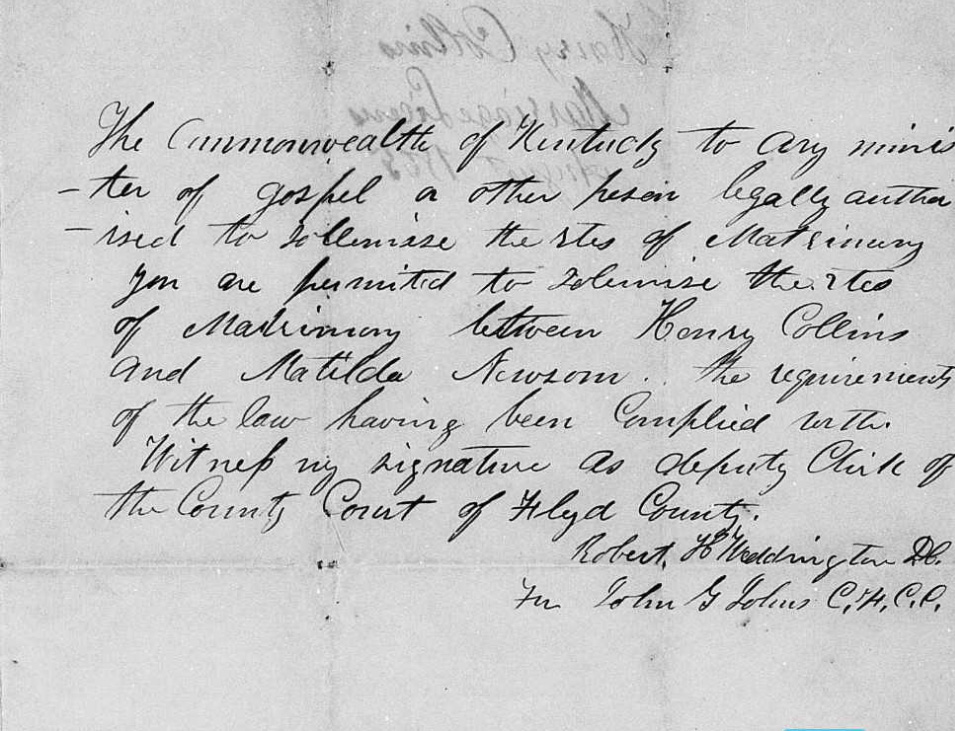
In 1866, Henry and Matilda were married in Floyd County. The marriage bond was issued under the name he was still using at the time: Henry Collins. This document serves as the primary genealogical link proving that Henry Holt and Henry Collins were the same individual. Shortly after his marriage, Henry felt safe enough to revert to his legal birth name.
By the 1880 census, he was listed in Floyd County as Henry Holt, a farmer living with Matilda and their children. This family unit included his son, Andrew Jackson Holt (born 1872), and daughter, Rena Holt (born 1879).
The 1890 Veterans Schedule
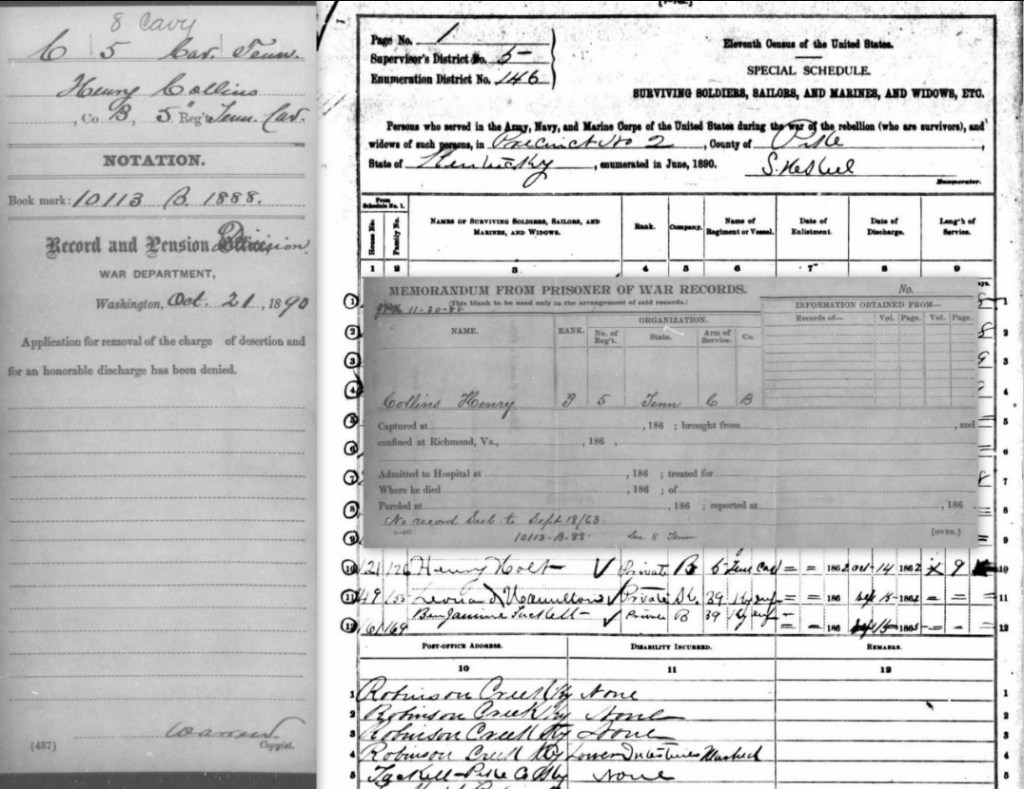
In 1890, Henry appeared on the Special Schedule of Union Veterans. In this record, he finally merged his two identities. He was listed as Henry Holt (indexed as “Nolt”), but he explicitly claimed service in the Tennessee Cavalry during the specific period he had served as “Henry Collins.” This provided a retrospective acknowledgment of his service under the alias.
For decades, the family knew Henry Holt as a “mean cuss”, a rough-hewn man who lived on the steep slopes of Bear Fork, carved out a ginseng patch, and kept a wary eye on strangers. He claimed to be a Union veteran, a cavalryman who had ridden with the 5th Tennessee. But when his grandsons asked about the war, the stories were always vague, and the government checks never came.
The truth was, “Henry Holt” didn’t exist until the Civil War ended.
The Boy Soldier Born around 1844 (though he often shifted his age to suit his needs), Henry was actually born Henry Collins, a surname that ties him directly to the Melungeon families of Newman’s Ridge in Hancock County, Tennessee.
In October 1862, a teenage Henry Collins enlisted in the Union Army, joining Company B of the 5th Tennessee Cavalry. He wasn’t a hero looking for glory; he was likely a poor boy looking for a meal and a uniform. But the war was unkind. Records show that “Collins, Henry” was captured by Confederate forces and confined in a prison camp in Richmond, Virginia.
The Escape and the Alias Sometime after September 1863, Henry vanished from the military rolls. He likely was paroled or escaped the prison camp, but he never returned to his unit. In the eyes of the U.S. Army, Henry Collins was a deserter.
Fearing execution for desertion or retribution from Confederate sympathizers back home in Tennessee, Henry fled north into the rugged isolation of Pike County, Kentucky. Somewhere on that journey, Henry Collins died, and Henry Holt was born. He likely took the surname “Holt” from a stepfather or maternal line to cover his tracks.
The 1890 Betrayal For thirty years, the ruse worked. Henry Holt married the widow Matilda Baldwin, raised a family, and hid in plain sight. But in 1890, old age and poverty forced his hand.
Hoping the government might have forgiven the chaos of the war, Henry applied for a veteran’s pension. In the 1890 Special Census of Surviving Soldiers, he boldly listed himself as “Henry Holt,” claiming service in the “5th Tenn Cavalry.”
The War Department was not fooled. On October 21, 1890, the Record and Pension Division issued a cold, bureaucratic rejection. They correctly identified “Henry Holt” as Henry Collins and noted that the “charge of desertion” still stood.
The Legacy Henry lived the rest of his life as an outlaw in the eyes of the government, denied the pension he desperately needed. But his act of survival, changing his name and hiding in the Kentucky hills, created the family we know today.
When he died in 1913, he was buried as Henry Holt. But we now know that the blood that runs in his descendants’ veins is the blood of the Collins clan—one of the oldest and most mysterious families of the Appalachians.
Later Life and Second Marriage
Matilda died in 1906, leaving Henry a widower in his 60s. In 1909, at the age of 65, he married Serilda “Rilda” Adams, a woman forty years his junior (born 1884). Due to the significant age gap, Rilda has occasionally been misidentified in records as the mother of Henry’s older children. However, dates confirm she was only five years old when Henry’s daughter Rena was born. Rilda was Henry’s second wife and a stepmother to his adult children, acting as his companion in his final years.
Henry Holt died in 1913 in Pike County, Kentucky. His life was defined by adaptation and reinvention. He survived the Civil War by assuming a new identity, outlived his first wife, and successfully transplanted his branch of the Holt family from the hills of Tennessee to the mountains of Kentucky.
Where the Rhine Meets the Ridge: The Genetic Legacy
For generations, the descendants of Henry Holt were told we were “Black Dutch” or part Cherokee. The oral history described dark skin, high cheekbones, and a mysterious lineage. Today, by combining advanced DNA analysis with rediscovered archival records, I have separated the myth from the biology.
The “German” Truth (The Paternal Line) The heavy percentage of Germanic and Dutch DNA (25%) found in the Holt profile does not come from a mystery source. It comes from Henry’s paternal grandmother, Elizabeth Bowman.
I traced Elizabeth back to the Baughman family (anglicized to Bowman). Her grandfather, Hans Jerg Baughman, was a German immigrant. Her father, William E. Bowman, was a pioneer of the highest order. He was a man who lived in Alum Cave to protect his family and built the first Methodist church in the valley. The Bowman line was characterized by intense loyalty and grit. This is best exemplified by Elizabeth’s grandfather, Cornelius Bowman, who famously refused to move to Kentucky without the body of his wife, Susan. In a testament to devotion, he exhumed her coffin, transported it by wagon across the frontier, and slept with it in his room because he “always loved Susan.” This is the fiery, Germanic stock that Henry Holt came from.
The “Cherokee” Legend (The Maternal Line) The persistent stories of Indigenous and African ancestry (the “Melungeon” markers) entered the family through Henry’s mother, Rutha Campbell. Rutha was the carrier of the Dobkins and Johnson legacy.
- The Legend: Her grandfather, Jacob Dobkins, was a Revolutionary War hero who served as an “Indian Scout” and testified to having “bullet holes through his clothes” after the Battle of Piqua. His role as a scout became the convenient cover story for the family’s darker features.
- The Biology: The true source of the “trace” Indigenous DNA (verified on Chromosome 10 & 20) was Rutha’s grandmother, Dorcas Johnson. The Johnson family was part of the mixed-race frontier community that settled on Little Sycamore Creek.
- This settlement was the heart of the Melungeon experience. Barred from mainstream society by the color of their skin and the mystery of their origins, families like the Johnsons retreated to the high ridges to survive. To protect themselves, they married within a tight circle of other mixed-race families—the Mullins, the Gibsons, and the Collins. This practice, born of necessity, didn’t just isolate them; it concentrated their unique genetic signature. It preserved the specific African and Native markers that allowed Henry Holt to bridge two worlds, even if he didn’t fully understand why.
The Convergence Henry Holt (1844) was the living embodiment of this convergence. When his father Preston (the son of the German Bowmans) married Rutha (the daughter of the Campbell/Dobkins line), they blended the sturdy German “Baughman” genetics with the complex, tri-racial “Johnson” genetics.
Henry Holt has always been an enigma. Long before verified records and genetic testing were available, his story was kept alive through front-porch conversations and handwritten histories. The following excerpt captures the essence of that lore, ranging from accounts of mountain justice to the persistent questions about his true paternity.
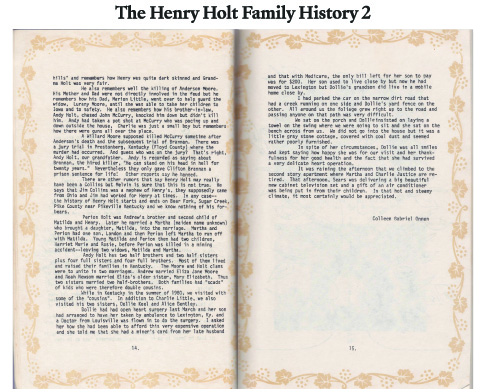
Bottom line: Henry Holt was not a single mystery. He was the intersection of two powerful American stories. He was the grandson of German pioneers who slept in caves and the son of a mother who carried the hidden genetic history of the Appalachian frontier.
Citations
1. 1900 U.S. Census Citation: 1900 U.S. census, Pike County, Kentucky, population schedule, Magisterial District 2, p. 11A (penned), dwelling 184, family 188, Henry Holt; digital image, Ancestry; citing National Archives and Records Administration microfilm publication T623, roll 548. Significance: Establishes Henry’s birth date (July 1844) and location in Kentucky later in life.
2. 1850 U.S. Census Citation: 1850 U.S. census, Grainger County, Tennessee, population schedule, District 11, p. 91A (stamped), dwelling 1590, family 1635, Henry Hatt in Preston Hatt household; digital image, Ancestry; citing National Archives and Records Administration microfilm publication M432, roll 880. Significance: Proves Henry’s parentage (Preston Holt) despite the “Hatt” transcription error and establishes his childhood proximity to the Collins neighbors.
3. 1860 U.S. Census Citation: 1860 U.S. census, Grainger County, Tennessee, population schedule, District 12, p. 520, dwelling 1050, family 1050, Henry Holt in Preston Holt household; digital image, Ancestry; citing National Archives and Records Administration microfilm publication M653. Significance: Confirms Henry (age 14) living with Preston Holt just prior to the Civil War, solidifying the link before he used the alias.
4. Compiled Service Records (Civil War) Citation: Compiled Service Records of Soldiers Who Served in Organizations from the State of Tennessee, Henry Collins, Pvt., Co. B, 8th Tennessee Cavalry (Union); digital images, Ancestry; citing National Archives and Records Administration microfilm publication M395. Significance: The official record of his service under the alias “Henry Collins.”
5. Floyd County Marriage Bond (1866) Citation: Floyd County, Kentucky, “Marriage Bonds, 1860-1867,” unpaginated, bond for Henry Collins and Matilda Newsom, 1866; digital image, FamilySearch. Significance: The “smoking gun” document where he marries his known wife (Matilda) using his alias (Henry Collins), linking the two identities.
6. 1880 U.S. Census Citation: 1880 U.S. census, Floyd County, Kentucky, population schedule, District 12, p. 48D (stamped), dwelling 49, family 49, Henry Halt household; digital image, Ancestry; citing National Archives and Records Administration microfilm publication T9, roll 413. Significance: Shows him reverted to his legal name “Henry Holt,” living with Matilda and children (Andrew and Rena).7. 1890 Veterans ScheduleCitation: 1890 U.S. census, Pike County, Kentucky, special schedule of Union Veterans and Widows of the Civil War, ED 109, p. 1, entry 13, Henry Nolt; digital image, Ancestry; citing National Archives and Records Administration microfilm publication M123, roll 6. Significance: Shows Henry Holt claiming service for the time period he was Henry Collins.
 CyberBarrett