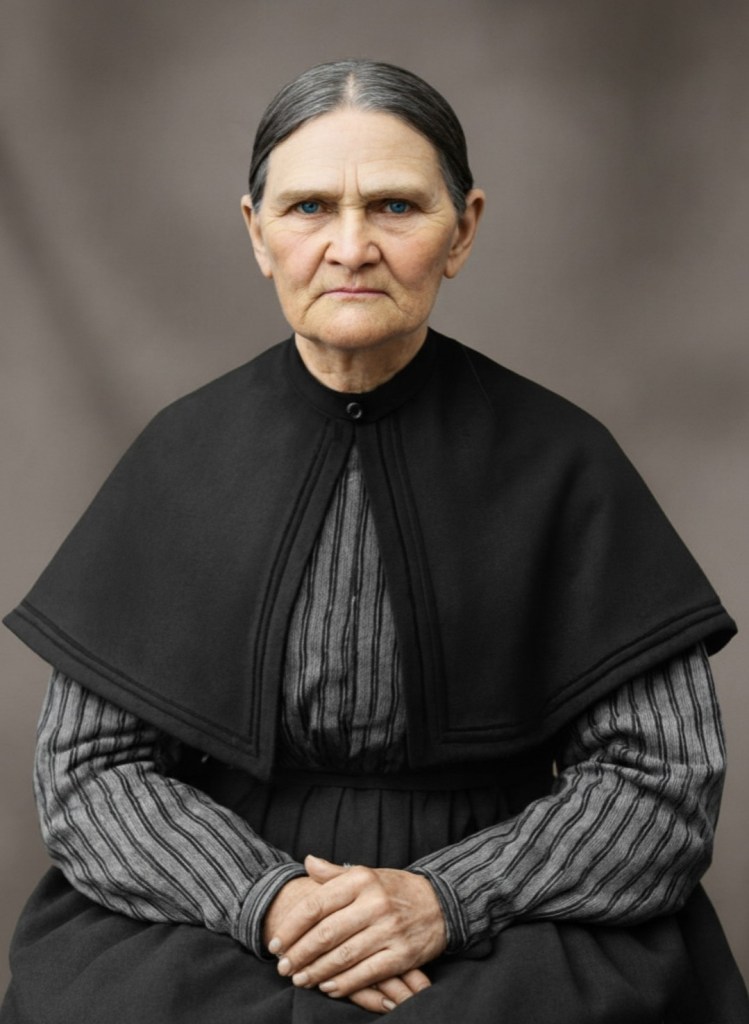
Matilda Baldwin sits at the crossroads of my ancestral research, representing a bridge between the documented history of the Mayflower and the oral traditions of the Melungeon frontier. My investigation into her life has focused on stripping away decades of “Black Dutch” and “Cherokee” labels to reveal the documented biological and historical truths of our lineage.
The Research Foundation
The reconstruction of Matilda’s life is built upon a “reasonably exhaustive search” of primary sources, including civil war pension rejections, marriage bonds, and multi-decade census analysis.
- The Mayflower Link: Through Matilda’s mother, Sarah Elliott, I have verified a direct line to Edward Doty, a passenger on the Mayflower. This documentation provides the formal framework for my application to the Mayflower Society.
- The Two Husbands: Matilda’s life was defined by two distinct Union families: the Newsoms and the Holts. My research successfully separated the children of her first husband, Lackey Newsom (killed in 1865), from those of her second husband, Henry Holt.
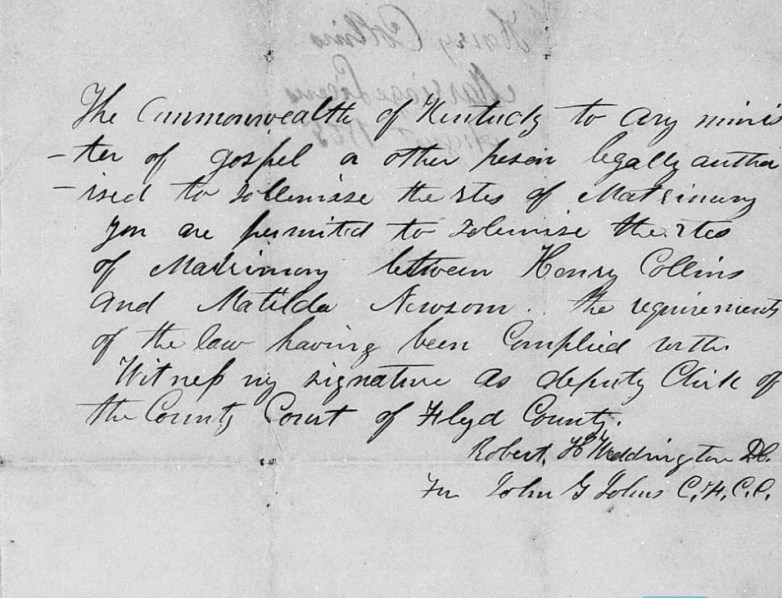
The Henry Holt Alias: A critical breakthrough in my research was identifying that my 2nd great-grandfather, Henry Holt, spent a significant portion of his early adult life living and serving under the alias Henry Collins. I discovered the “smoking gun” in the 1866 Floyd County marriage bond, which was issued to him under the name “Henry Collins” for his marriage to Matilda. This document serves as the primary genealogical link, finally connecting his legal birth name to the identity he used to escape military prosecution and solve a century-old family mystery. Full story here:
Correcting the Record
While this census is a primary source, my research has identified two points where the enumerator’s data conflicts with the broader evidence:
- Birthplace of Parents: The record lists both of Matilda’s parents as being born in Virginia. This is correct for her father, Solomon Baldwin, but I have found records indicating her mother, Sarah Elliott, was likely born in Kentucky or North Carolina, depending on the document.
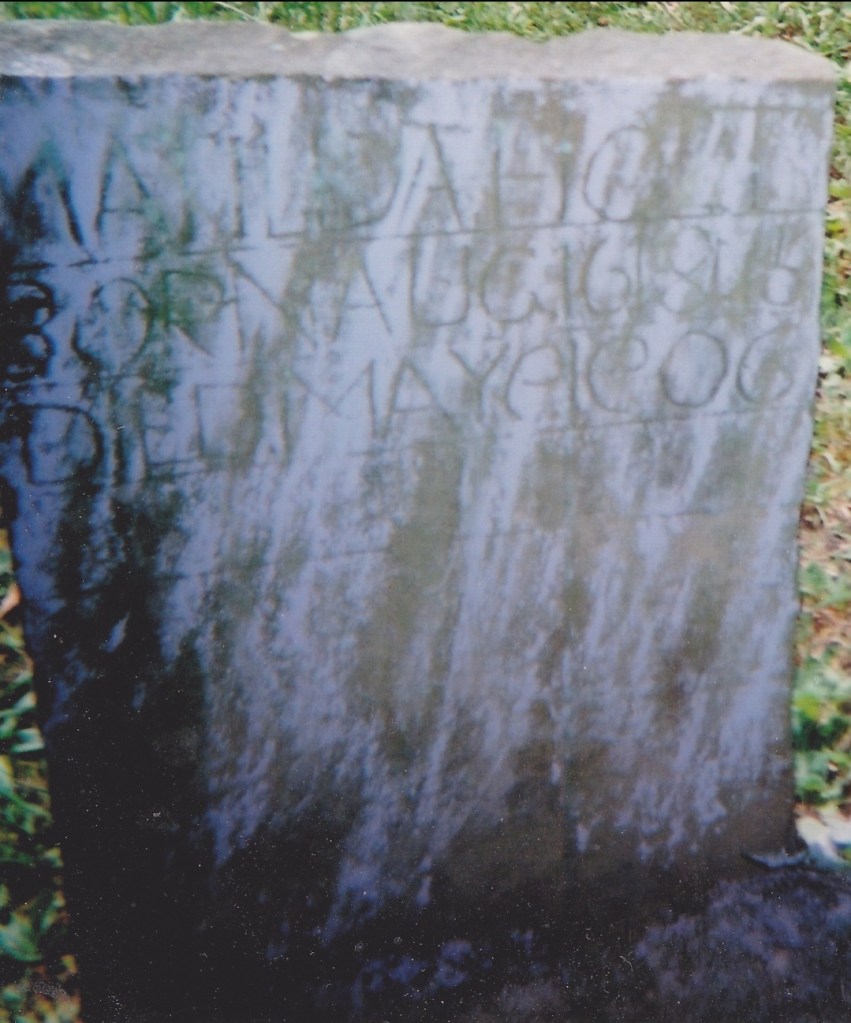
- Birth Month: It lists Matilda’s birth as August 1844. However, other family records and her gravestone at Sam Hall Cemetery consistently point to 1845.
- The 1865 Marriage Date: This record claims she had been married to Henry for 35 years, pointing back to 1865. This supports my findings that while their legal bond was recorded in 1874, they were living as a family unit immediately following the death of Lackey Newsom.
The Melungeon Convergence
My research moves beyond the vague “Cherokee” stories of the past to identify specific Melungeon markers on both sides of Matilda’s family.
- The Maness Line: On the Baldwin side, I have identified the Maness surname as a key Appalachian tri-racial marker.
- The Collins/Johnson Line: On the Holt side, I have traced the lineage back to the Johnson and Collins families of Newman’s Ridge, the historical heart of the Melungeon community.
This powerful convergence of two storied Appalachian lineages meeting in one cabin is why the children often appeared “pure Indian” to relatives like Miram Rosik. It was not a single “mystery tribe” at work, but the concentrated genetic signature of two distinct branches of the Melungeon frontier coming together in the Kentucky hills.
A Note on Family Lore and Memoirs
While my primary focus is on verified data, the oral histories passed down through the generations provided the initial clues for my search. These stories, though often containing factual errors regarding ages and military service, capture the “spirit” of the family’s experience in the Kentucky hills.
Explore the Lore: I have archived the original memoirs of Fern Rosik Glasgow and Miram Rosik on a separate page. These stories offer a window into how the family viewed themselves before modern DNA and archival access allowed us to document the full truth. READ HERE:
Matilda Baldwin: The Matriarch of the High Ridges
Matilda Baldwin did’t just survive the rugged isolation of the Kentucky mountains; she mastered them. Living on a “little flat place” carved out of the Straight Fork of Bear Fork, she raised twelve children in a log cabin that
served as a schoolhouse, a pharmacy, and a sanctuary.
Unpacking the “House Divided”
The Newsom Children (The Union Tragedy)
- John Wesley, Mahala, and Noah Webster were the children of Lackey Newsom, a Union soldier.
- Because Lackey was killed by his own side, these children grew up with a complicated legacy of sacrifice and “friendly fire”.
- Matilda ensured they stayed rooted on the Robinson Creek land Lackey had inherited, preserving their Newsom identity even after she married a man they reportedly did not like.
The Holt Branch (The Legacy of Reinvention)
- The nine children Matilda had with Henry, including my 2nd great-grandfather Perian Holt, grew up in a completely different environment on the rugged slopes of Bear Fork.
- While the Newsoms were established landowners, the Holts were “carving out” a new life on a “little flat place” in the wilderness.
- These children were the first generation to carry the Holt name, a name created out of necessity by a man fleeing the chaos of Tennessee.
I have verified the statement in this record that Matilda had 12 children, with 11 still living in 1900. This count closely aligns with my reconstructed list of four Newsom and nine Holt children, totaling 13 recorded births. The slight discrepancy in the census count likely reflects the tragic reality of infant mortality that predated the 1900 record. Also in the 1900 census, the presence of 10-year-old Rhoda Caudill in the house confirms the family memoirs. It proves my theory that Matilda’s home was a sanctuary not just for her children, but for grandchildren who needed a stable place to grow up on the Straight Fork. I know this not just from census data, but from a specific “runaway” incident recorded in our family lore. When Landon ran away as a young man, Matilda was the only person with the social authority to bring Henry, who was normally banned from the property, onto the Newsom farm to search for him. I believe Landon fled the strictness of Henry’s household after Matilda’s death. Without her there to soften Henry’s “mean cuss” reputation, Landon sought a new path, and Matilda’s final act of mediation (recorded in our lore) was ensuring he was found and brought back into the family fold. This confirms for me that Matilda was the “safety net” for the family, ensuring the connection to “Granny Holt” remained unbroken even when her children and grandchildren sought a new path.
The Connection: Landon was the son of Perian Holt (who died in 1909) and Martha Jane “Patsy” Tackett.
The Evidence: When Perian died in 1909, the unified Holt household founded by Matilda provided the central “Safety Net” for his children from both the Kentucky and Virginia branches..
One of the most touching aspects of my research is the evidence that Matilda’s role as a mother never truly ended. I have found that she helped raise her grandson, and my grandfather, Landon Holt (1899–1976), in her own household.
A life of service to the community
Through my analysis of the local geography and the complete lack of medical facilities in the region at the time, I’ve identified Matilda as the de facto hospital for Robinson Creek.
- A Practitioner of Necessity: I believe Matilda utilized my 2nd great-grandfather Henry’s famous ginseng and local herbal lore to care for women who had no other medical options.
In a time and place where the nearest hospital was a multi-day journey away, Matilda was the biological and medical lifeline for her neighbors. As a “Granny Midwife,” her expertise was a blend of inherited Mayflower grit and the deep botanical wisdom of the Melungeon ridges.
The Necessity:
- Without formal doctors, Matilda relied on her knowledge of the land, likely:
- Ginseng (Panax quinquefolius): Henry Holt was pretty famous for his ginseng patch, and while he sold it for income, Matilda likely used it as a general tonic to boost the immune systems of postpartum mothers and elderly neighbors.
- Yellowroot and Goldenseal: Common in the Pike County hollows, these were the “antibiotics” of the 19th century. Matilda would have used them to treat infections, mouth sores, and “thrush” in newborns.
- Pennyroyal and Raspberry Leaf: Essential for a midwife, these herbs were used to ease labor pains and regulate “female troubles”.
- The Midwife’s Kit: Beyond herbs, her “kit” was sparse—clean linens, a sharp knife for the cord, and perhaps a small bottle of whiskey or brandy used as a primitive antiseptic.
- The Peacemaker at the Bedside: Her role as a midwife often transcended medicine. Though a deep rift existed between her Newsom sons and her husband Henry, Matilda was the only one allowed to cross those battle lines. When a new Newsom or Holt grandchild was entering the world, the feuds were silenced as Matilda took charge of the birthing room.
- Cultural Sanctuary: For the Melungeon women of the surrounding ridges, families like the Collinses and Johnsons who were often marginalized by society, Matilda was a trusted ally who understood their hidden history and provided the care they were denied in the “valleys”
In the “Statistical Heart” of Matilda’s story, it shows her at age 55, a literate, industrious housewife who had successfully raised nearly all of her children to adulthood despite the extreme isolation of Magisterial District 2.
Her literacy adds a layer of depth to her role as a “Granny Midwife,” as she likely kept her own records or read medical lore of the time.
The Enduring Legacy of “Granny Holt”
Matilda Baldwin’s story is more than a collection of dates and census records; it is the story of the American frontier itself. She was the silent force that stabilized a family divided by the scars of the Civil War and the social isolation of the Kentucky ridges. By documenting her life, I have been able to reconcile the legendary “Cherokee” stories of my youth with the biological truth of her Melungeon heritage and her documented descent from the Mayflower pilgrims.
She stood as a guardian of the family’s health and history, ushering new generations into the world as a midwife while ensuring her own grandchildren had a safe harbor in her home. Her life serves as a testament to the fact that our ancestors did not have to choose one identity; they were the living bridge between the Old World of the Atlantic and the hidden, resilient world of the Appalachian heights.
A Quiet End to a Life of Service
Matilda’s life ended exactly as she had lived it, in the middle of domestic life and community connection. In 1906, at age 62, she suffered a heart attack while churning butter and talking to her daughter-in-law, Eliza Jane Holt. She was buried at the Sam Hall Cemetery, leaving behind a legacy as a woman who could bridge the gap between a Pilgrim past and a Melungeon future.
Primary Source Appendix: Matilda Baldwin (1845–1906)
- Marriage Bond (1860): Floyd County, KY. Documenting the marriage of Matilda Baldwin (age 14) to Lackey Newsom.
- Civil War Service Record (1861–1865): 39th Kentucky Infantry, Co. K. Documenting Lackey Newsom’s enlistment and burial.
- Marriage Bond (1866): Floyd County, KY. The “smoking gun” document issued to Henry Collins and Matilda Newsom.
- U.S. Federal Census (1870): Precinct 5, Laynerville, Floyd, KY. Showing Henry and Matilda living together with the first branch of Holt children.
- U.S. Federal Census (1880): Antioch, Floyd, KY. Listing Henry Holt, Matilda, and children including Andrew Jackson Holt.
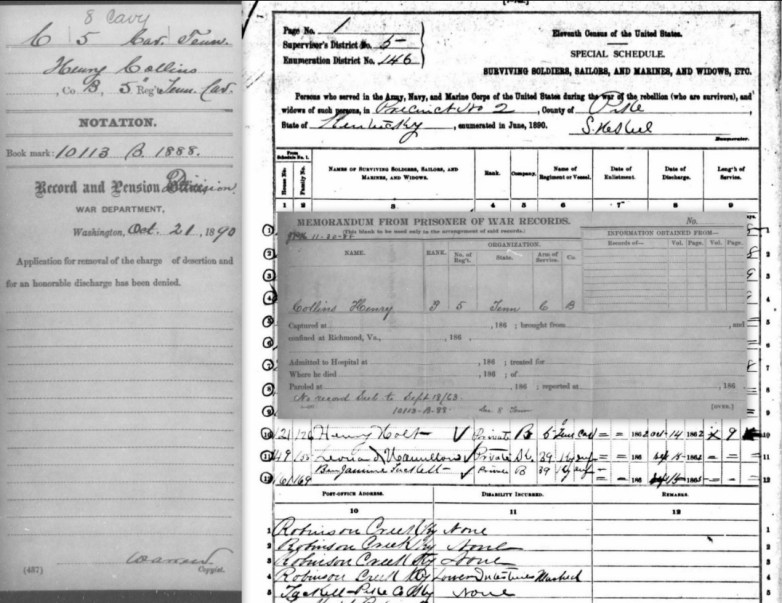
- Veterans Schedule (1890): Pike County, KY. Documenting Henry Holt’s claim of service in the 5th Tennessee Cavalry—the record that officially linked the Holt and Collins identities via the Pension Bureau’s rejection.
- U.S. Federal Census (1900): Magisterial District 2, Pike, KY. Confirming Matilda’s literacy, 35-year marriage, and the presence of granddaughter Rhoda Caudill.
Death & Burial Record (1906): Family Bible and Sam Hall Cemetery markers confirming Matilda’s death on May 1, 1906.
The link between Henry Holt and Henry Collins is scientifically proven by the 1890 Special Schedule. In that record, Henry Holt explicitly claimed the service dates and unit (5th/8th Tennessee Cavalry) belonging to the soldier recorded as Henry Collins. This retrospective acknowledgment, combined with the 1866 marriage bond, creates an unbroken chain of identity.
Matilda Baldwin’s Two Families:
Husband 1: Lackey G. Newsom (1838–1865)
- John Wesley Newsom (1861–1927)
- Ina Mae Newsom (1862–1928)
- Mahala Newsom (1863–1928)
- Noah Webster Newsom (1865–1947)
Husband 2: Henry Holt (Collins) (1844–1913)
- Noah Holt (1865–1950)
- Mary Holt (1866–1953)
- Evan Holt (1870–1952)
- Andrew Jackson Holt (1872–1944)
- Darcus Sious Holt (1874–1957)
- Perian Holt (1875–1909)
- Silas Holt (1877–1936)
- Rena Holt (1879–1925)
- Liza Holt (1882–1964)
 CyberBarrett